

Gujarati wedding invitations: Kankotri wording and the full ritual order
The Gujarati wedding invitation has its own name, Kankotri, and its own conventions. It is traditionally written to be read aloud, which is why the phrasing sounds formal even when the family is not.
This page runs through the ceremonies in the order they happen, which the invitation usually lists, and gives wording in both Gujarati and English.

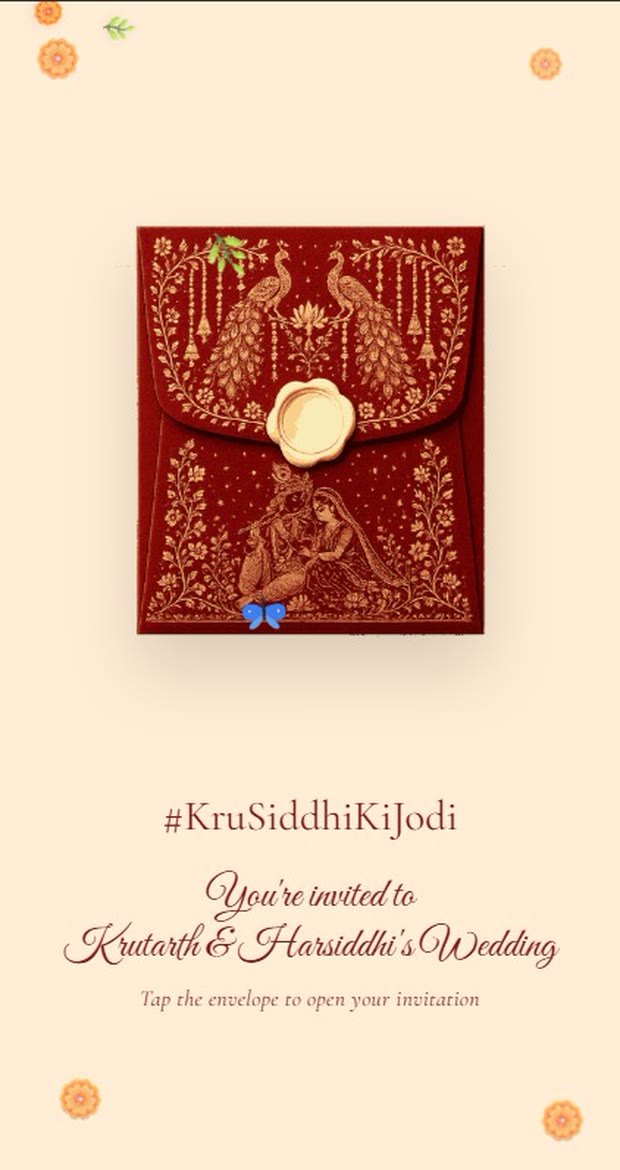


The ceremonies in order
| Ceremony | What happens | When |
|---|---|---|
| Chandlo Matli | The bride's father and male relatives visit the groom's home, apply a chandlo on his forehead and give shagun. The match is formalised. | Engagement stage |
| Gol Dhana | Jaggery and coriander seeds are distributed. The formal engagement, often with both families together. | Engagement stage |
| Mandap Muhurat | A puja at both homes to consecrate the mandap before the wedding days begin. | Days before |
| Griha Shanti | A ceremony for peace and to remove obstacles, held at both homes. | Days before |
| Pithi | The turmeric ceremony, at both homes. | One to two days before |
| Garba and Sangeet | Music and dandiya, usually the biggest social evening of the whole wedding. | Evening before |
| Jaan and Ponkhana | The groom's procession arrives. The bride's mother welcomes him, and playfully pulls his nose. | Wedding day |
| Jaimala, Kanyadaan, Hasta Milap | Garland exchange, the giving of the bride, and the joining of hands under the shawl. | Wedding day |
| Mangal Phera | Four rounds of the sacred fire, one each for dharma, artha, kama and moksha. | Wedding day |
| Saptapadi and Vidaai | Seven steps, then the bride's departure. | Wedding day |
How a Kankotri is usually written
- Opens with Shree Ganeshaya Namah, or Shree Krishnah Sharanam Mama in Vaishnav families.
- Names the elders of the family first, often including grandparents, before the couple.
- Lists each function with its date and time, since a Gujarati wedding usually spans several days.
- Traditionally written in the third person and in a formal register, even in English versions.
- Frequently mentions Bhojan Vyavastha, the meal arrangement, with timing.
Kankotri wording you can copy
Copy any of these and change the names, dates and places. They are written to be read out loud, so they sound right on a phone screen too.
Shree Ganeshaya Namah
Amara parivar na shubh prasange, aapne sahkutumb padharva aagrahbhari vinanti.
Chiranjeevi [Naam]
suput [Pita nu naam]
sathe
Aayushmati [Naam]
suputri [Pita nu naam]
Lagna: [Divas, Tarikh] · Muhurat [Samay]
Sthal: [Sthal]
Shree Ganeshaya Namah
Mr and Mrs [Surname]
cordially invite you with your family
to the wedding of their daughter
[Name]
with
[Name]
son of Mr and Mrs [Surname]
[Day, Date] · Muhurat [Time]
[Venue]
Lunch will be served from [Time].
Shree Ganeshaya Namah
[Name] and [Name] are getting married.
Garba: [Date] · [Time]
Pithi: [Date] · [Time]
Lagna: [Date] · Muhurat [Time]
[Venue]
Aap sarve ne sadar aamantran.
Want these words on a real invitation website? See the designs
Gujarati Wedding Invitation invitation designs
6 designs you can personalise, from ₹2499. Tap any one to open it full size with a live demo.


Questions people actually ask
What is a Kankotri?
The Gujarati word for a wedding invitation card. It is traditionally written formally and in the third person, because it was meant to be read aloud to a gathering.
How many pheras in a Gujarati wedding?
Four, called Mangal Phera, one each for dharma, artha, kama and moksha. This differs from the seven of many North Indian traditions, and the Saptapadi follows separately.
What is Ponkhana?
The moment the groom's procession arrives and the bride's mother welcomes him, then playfully pulls his nose. It is meant to remind him to stay humble, and it is the most photographed moment of a Gujarati wedding.
What is the difference between Chandlo Matli and Gol Dhana?
Chandlo Matli is when the bride's family visits the groom's home to formalise the match. Gol Dhana is the engagement itself, named for the jaggery and coriander distributed.
Should the Kankotri be in Gujarati or English?
Many families print both, or use Gujarati for the invocation and family names and English for logistics. A digital invitation can carry both without doubling the cost of printing.